
What’s in this guide
- How commercial roofing differs from residential
- TPO, EPDM, PVC and modified bitumen
- What a commercial roof really costs
- Warning signs your roof needs attention
- Insurance claims on a commercial roof
- Choosing a qualified contractor
- The installation process, step by step
- Commercial roof warranties
- Your decision checklist
When your facility manager tells you the roof needs attention, you’re looking at a decision that could cost anywhere from a few thousand dollars for repairs to well over a few hundred thousand dollars for a complete replacement. Unlike residential roofing, commercial roof decisions affect your operations, your bottom line and your building’s energy efficiency for the next 20 to 30 years. Some businesses may also be able to write off a new roof in the first year under Section 179, though this isn’t tax advice or a guarantee.
How Commercial Roofing Differs From Residential Roofing
Quick Answer: Commercial roofing uses completely different systems, installation methods, and considerations than residential roofing. While your home might have asphalt shingles on a steep slope, most commercial buildings have flat or low-slope roofs with membrane systems designed for very different performance requirements.
“In a lot of ways, commercial is different,” explains Lyle Lehman, owner of Better Way Roofing. “Different roof systems, different process of installation.”
Here’s what makes commercial roofing unique:
Roof Structure and Pitch Most commercial buildings have flat or low-slope roofs, though “flat” is often a misnomer. “Some roof structures will still be pitched, but only like a quarter twelve pitch or so,” Lyle explains. Building codes typically require a quarter inch per foot minimum slope. “The roof deck can be pitched or it can be totally flat, but then the insulation needs to be tapered to get the quarter twelve pitch and so that water runs towards the drains for proper drainage.”
Different Systems, Different Stakes While steep-slope commercial buildings might still use shingles or metal, most commercial roofs use membrane systems. “Some will be low slope commercial metal. It’s a thicker panel, it’s got a lot of different metal panels they can use, like trapezoidal,Crimped or Raised seam hidden fastener,” Lyle notes. “A lot of it’s 20, 22, or 24 gauge.”
But the biggest difference isn’t just the materials. It’s what’s riding on your decision: your business operations, employee comfort, tenant satisfaction, and long-term operating costs. A residential roof leak is stressful. A commercial roof leak during business hours can cost you thousands in lost productivity, damaged inventory, and emergency repairs.
The Buildings We’re Talking About Commercial roofing applies to churches, schools, warehouses, industrial buildings, office buildings, retail spaces, and any other non-residential structure. Each has unique requirements based on what happens inside and how the building is used.
Understanding Commercial Roofing Systems: Your Four Main Options
Quick Answer: Most commercial flat roofs use one of three main membrane systems: TPO, EPDM, or PVC. Modified Bitumen exists but is becoming outdated. Each system has different costs, lifespans, and ideal applications.
TPO (Thermoplastic Polyolefin)
TPO has become the most common commercial roofing membrane in recent years, and for good reason.
“TPO is probably the most typical, most common,” Lyle explains. It’s also the most cost-effective option. “I mean, they’re all very similar in cost, but typically TPO is the cheapest of the three.”
What makes TPO popular:
- White reflective surface for energy efficiency
- Heat-welded seams create watertight bonds
- Good balance of performance and cost
- Wide availability and contractor familiarity
Expected lifespan: 15-20 years with proper maintenance
Best for: Cost-conscious projects, standard commercial applications, buildings prioritizing energy efficiency
EPDM (Rubber Roofing)
EPDM has been around longer than TPO and PVC, earning it the nickname “the proven track record.”
“EPDM’s been around the longest, so I guess you could say it’s got more of a proven track record,” Lyle notes. It’s a rubber membrane, typically black, though white EPDM exists.
What makes EPDM reliable:
- Decades of proven performance
- Relatively simple installation
- Good for DIY repairs if needed
Expected lifespan: 15-20 years
Best for: Building owners who value proven technology, projects where upfront cost matters most, situations where dark roofing isn’t a concern
PVC (Polyvinyl Chloride)
PVC is the premium option, commanding the highest price but offering the longest lifespan.
“PVC is a white membrane,” Lyle explains. “The white reflectivity lets it expand and contract with the weather, so it doesn’t crack and get brittle as quick.” But you can also get PVC that has a secret weapon: “You can get PVC with Elvaloy in it which acts as a solid non migrating plasticizer,which gives it more flexibility so that helps protect it from cracking and getting brittle quick.”
What makes PVC premium:
- Superior chemical resistance (critical for restaurants and facilities with HVAC exhaust)
- Most durable seam strength
- Longest lifespan of the three systems
- Best resistance to oils, grease, and chemicals
Expected lifespan: 20 to 25 years
Best for: Restaurants, buildings with heavy HVAC equipment, facilities where chemical resistance matters, long-term ownership scenarios
Modified Bitumen: The Outdated Option
You might hear about Modified Bitumen, but it’s increasingly rare. “I don’t know any companies that are still doing the modified,” Lyle admits. Most contractors have moved to TPO, EPDM, or PVC for better performance and easier installation.

“Don’t pick your roofing system on price per square foot alone. Look at the total cost over the life of the roof. A PVC roof that runs 20% more but lasts 50% longer often gives you a better return than the cheapest TPO option.”
The True Cost of Commercial Roofing
Quick Answer: Commercial roof costs vary dramatically based on building size, system complexity, and material choices. Small repairs might cost a few thousand dollars, while complete replacements on large buildings can exceed well over $100,000. Understanding what drives these costs helps you budget accurately and avoid surprises.
What Affects Your Commercial Roof Price
“Size can affect it,” Lyle explains, but that’s just the beginning. Here are all the factors that influence your final cost:
Building Characteristics:
- Square footage (the obvious one)
- Number of stories (“The number of stories can affect it”)
- Roof access and working conditions
- Number of penetrations (“How many penetrations it has on the roof can affect it”)
Existing Roof Conditions:
- Number of layers to remove (“How many layers of old roofing on the roof can affect it”)
- Deck type and condition (“Whether the roof deck is wood, metal, light concrete, hard concrete can affect it”)
- Moisture in existing insulation
- Structural issues that need addressing
New System Specifications:
- Membrane choice (TPO vs EPDM vs PVC)
- Insulation thickness (“The thickness of the ISO, which is an insulation”)
- Membrane thickness (“The thickness of the membrane”)
- Installation method
Installation Methods: Mechanically Fastened vs Fully Adhered
How your membrane gets attached makes a significant cost difference.
“Mechanically fastened, you install a plate and screw along the seams 12” apart then we run the robotic welder at 800-1100 degrees along the seam to weld the two pieces together,” Lyle explains. “Fully adhered, we glue the complete membrane to the ISO board including the seams.
Fully adhered systems typically cost more but offer better wind resistance so it’s more ideal for high rises or coastal buildings that tend to get more wind. The right choice depends on your building’s wind exposure, budget, and warranty requirements.
Understanding ROI on Commercial Roofing
“Building owners would rather not spend it on the roof if they don’t have to because most people will never see when visiting the facility however it’s what protects the complete operation,” Lyle acknowledges. That’s exactly why you need to think beyond upfront cost.
Calculate total ownership cost:
- Upfront installation cost (your starting point)
- Energy savings (white reflective roofs can cut cooling costs 10-20%)
- Maintenance costs (factor in annual inspections and minor repairs)
- Expected lifespan (divide total cost by years of service)
- Avoided emergency repairs (prevention is cheaper than crisis response)
A $60,000 TPO roof lasting 18 years costs $3,333 per year. A $75,000 PVC roof lasting 28 years costs $2,678 per year. The “expensive” option actually costs less.
Warning Signs Your Commercial Roof Needs Attention
Quick Answer: Commercial roofs send clear distress signals before catastrophic failure. Seams coming loose,large amounts of ponding water lasting for more then 2 days and membrane deterioration all indicate your roof needs professional evaluation soon.
The Signs You Cannot Ignore
“Oftentimes the seams will be coming loose,” Lyle explains. “That’s one of the first signs of potential issues. The seams and penetrations start deteriorating and coming loose, and the membrane itself will be getting brittle and showing wear.”
Critical warning signs:
Ponding Water Large amounts of ponding water after rain indicates drainage problems. This accelerates membrane deterioration.
Seam Separation The seams between membrane sheets are your roof’s first line of defense. When they separate, water intrusion is imminent.
Membrane Cracking or Blistering Brittle, cracked, or blistered membrane indicates UV degradation and aging.
Flashing Failures Flashings around HVAC units, pipes, and roof edges are common leak points. Pulling away, rust, or deterioration here means trouble.
Interior Evidence Water stains on ceilings, mold growth, or musty odors signal water is already getting through. This is past the warning stage.
When Repair Makes Sense vs When You Need Replacement
“If you can repair it properly, then sure,” Lyle says. But here’s the honest truth: “Oftentimes trying to do a repair, if the roof is older than 15 years, oftentimes repairing will just be a band aid on a bigger wound.”
Repair makes sense when:
- The roof is less than 15 years old
- Damage is localized to a small area
- The membrane elsewhere is in good condition
- You’re planning replacement within 3 to 5 years anyway
Replacement is necessary when:
- The roof is 15+ years old with widespread issues
- Multiple areas need repair
- Seams are failing throughout
- Your looking for a 15-20 year solution
“If EPDM is on it and there’s a section that got wind damage or came loose for whatever reason, we could put that back intact and glue it down and repair it as best as possible,” Lyle explains. But repairing aged systems is like patching a 20-year-old tire. It might hold for now, but you’re delaying the inevitable.
“If your roof is getting close to 15 years old and you’re looking at repairs over $5,000, get a full replacement quote too. Sometimes the gap between major repairs and a complete replacement is smaller than you’d think, and replacement buys you 20 more years instead of 3 to 5.”
Dive deeper into the topics that matter most for your commercial roof decision.
Commercial Roof Insurance Claims: What You Need to Know
Quick Answer: Commercial roofs qualify for insurance claims the same way residential roofs do, but only if you have proper hail or wind damage and replacement cost coverage.
“If there’s proper wind or hail damage, then yes, they can get a claim started for it and claim it on their insurance,” Lyle explains. “If it’s proper hail or wind damage and they have replacement cost coverage.”
Critical insurance considerations:
Not All Commercial Policies Are Equal Some commercial policies have actual cash value (ACV) coverage only, meaning you’ll receive the depreciated value of your roof, not enough to replace it. Others have stated limits on roof coverage that might not cover a full replacement.
Check your policy now, not after storm damage. Look for “replacement cost” coverage and verify the coverage limit is adequate for your building size.
Documentation Is Everything Insurance adjusters want proof. Before-and-after photos, professional inspection reports, and detailed damage documentation strengthen your claim. The standards from residential claims apply here: adjusters work for the insurance company, not you.
Business Interruption Matters A major roof failure doesn’t just cost you the roof. It can cost you lost business days, damaged inventory or equipment, and potentially tenant relationships. Some policies cover business interruption. Make sure you understand what’s included.
Choosing Your Commercial Roofing Contractor: Critical Qualifications
Quick Answer: Commercial roofing requires specific expertise, higher insurance minimums, and manufacturer certifications that residential contractors might not have. Verify credentials before signing anything, and don’t assume a good residential roofer can handle commercial work.
The Insurance Requirements That Matter
“Some of them, you need to have $2 million in liability coverage depending on what they got inside,” Lyle explains. “That’s what we have anyway, and that’ll cover, you know, it’ll exceed what we need on residential, but it equates to what we need on commercial.”
Required insurance verification:
- $2 million general liability insurance minimum
- Workers compensation coverage (non-negotiable)
- Proof of bonding (If required in municipality)
- Current certificates (not just “we have insurance”)
Manufacturer Certifications: Not Optional
“Usually you’ll need to do a training on which systems you’re installing,” Lyle notes. “Whether it be Mule Hide, Conklin, they all got trainings and manufacturer specs to follow for warranty certification.”
Why this matters: installing commercial roofing systems without proper certification can void manufacturer warranties. You might save money upfront with an uncertified installer, but you’re gambling with warranty coverage worth tens of thousands of dollars.
Key certifications to look for:
- Mule Hide system certification
- Conklin approved contractor status
The Questions That Separate Professionals From Pretenders
Don’t just ask “can you do commercial roofing?” Ask specific questions:
“How many commercial roofing projects do you complete annually?” You want a contractor doing dozens of commercial projects yearly, not someone doing one or two as side work.
“Which manufacturer systems are you certified to install?” They should name specific certifications, not vague “we work with everyone” answers.
“Can you provide three commercial references in my industry?” A contractor experienced with church roofs understands different challenges than one who only does warehouse work.
“How do you handle business operations during installation?” This question reveals whether they’ve thought about your needs beyond just installing a roof.
“What’s your approach to project planning and timeline?” Commercial projects need coordination. “Basically, we need to do a recap of our plan as to the process of the project, what we’re planning on doing each day,” Lyle explains. You want contractors who proactively communicate, not ones you have to chase down.
Red Flags: When to Walk Away
❌ Primarily residential contractors trying to break into commercial work
❌ No manufacturer certifications or “we’ll get those later”
❌ Can’t provide commercial-specific references
❌ Pressure to choose the cheapest option without explaining tradeoffs
❌ Vague about insurance minimums or “our insurance covers everything”
The Commercial Roof Installation Process: What to Expect
Quick Answer: Commercial roof installation involves more planning and coordination than residential work. From comprehensive inspections using specialized equipment to phased installation schedules that minimize business disruption, expect a process designed around keeping your business operational.
Step 1: Comprehensive Roof Inspection
Commercial roof inspections go far beyond visual assessment.
“On an inspection, typically we’ll look at all seams, penetrations, drains, the actual membrane itself, gauging as to the approximate lifespan or life cycle remaining,” Lyle explains. “And ponding water, obviously.”
Advanced inspection techniques:
Core Sampling “We’ll do core samples,” Lyle notes. This involves cutting small samples through all roof layers to examine insulation condition, membrane thickness, and deck style.
Infrared Scanning “Usually we only do that if we’re looking for a leak,” Lyle explains about infrared technology. “We can use it if we’re trying to pinpoint a leak, or we’re thinking of doing an overlay and we need to see what the ISO underneath looks like.”
Infrared scanning reveals moisture trapped under the membrane that isn’t visible from above. This prevents installing new roofing over hidden water damage.
Structural Assessment The inspection evaluates whether the deck can support new roofing systems, especially if you’re adding insulation or switching to heavier materials.
Step 2: Project Planning and Coordination
“Basically, we’ll do a recap of kind of our plan as to the process of the project, what we’re planning on doing each day,” Lyle explains. “Basically give the client a workflow recap of the game plan, what we’re thinking each day.”
Key planning elements:
- Timeline broken down by project phase
- Material delivery schedule
- Equipment staging areas
- Worker arrival and departure times
- Noise and activity windows
- Weather contingency plans
This isn’t just courtesy. Poor planning on commercial projects can disrupt business operations.
Step 3: Site Preparation and Safety
OSHA requirements apply to commercial roofing, not just as contractor responsibility but as building owner liability.
“We put up safety cones, caution tape around the perimeter, per OSHA requirements,” Lyle explains.
Site preparation includes:
- Perimeter barriers and warning signs
- Protection for roof equipment
- Secure areas for material storage
- Pedestrian safety zones
- Coordination with building managers
Step 4: The Installation Work
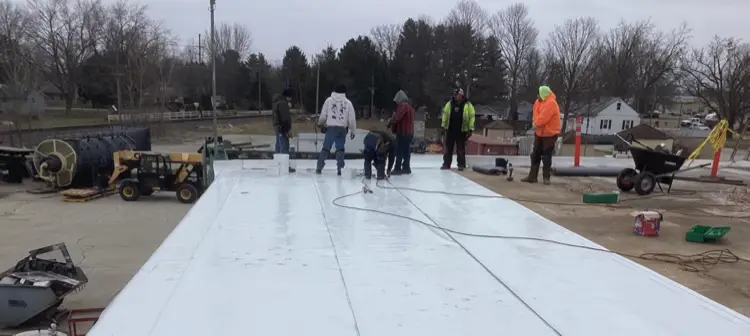
Installation method depends on your chosen system and attachment type.
For tear-off projects:
- Remove existing roofing layers
- Inspect and repair deck as needed
- Install tapered insulation (if applicable)
- Install new insulation layer
- Install membrane (mechanically fastened or fully adhered)
- Detail all flashings, penetrations, and edges
- Install roof drains and accessories
For overlay projects:
- Clean and prepare existing membrane
- Install additional insulation (if specified)
- Install new membrane over existing
- Detail penetrations and edges
- Test all seams
Step 5: Final Inspection and Warranty Registration
“In areas where it’s required, the building department will come out and do a final inspection,” Lyle explains. Manufacturer inspections happen less frequently: “As per manufacturer, they would just once a year hit a project or their required amount per manufacturer requirement.”
Minimizing Business Disruption
The best commercial roofers think about your business first, their work second.
Strategies contractors use:
- Weekend or after-hours installation (more expensive but sometimes necessary)
- Phased installation (complete sections while others remain operational)
- Noise management protocols
- Dust and debris containment systems
- Coordinated access that doesn’t block deliveries or employee parking
Understanding Commercial Roof Warranties
Quick Answer: Commercial roof warranties come in three types: manufacturer material warranties (10 to 30 years), contractor workmanship warranties (5-20 years), and system warranties that cover both materials and labor. Read the fine print carefully because maintenance requirements and unauthorized modifications void coverage.
The Three Types of Warranties
Manufacturer Material Warranties These cover defects in the roofing materials themselves. Length varies by membrane type and quality tier, ranging from 10 years for basic materials to 30 years for premium PVC systems.
Contractor Workmanship Warranties These cover installation errors. Reputable contractors typically offer 2 to 10 year workmanship warranties, though lengths vary significantly.
System Warranties The gold standard. Manufacturers offer comprehensive system warranties (also called “NDL” or “No Dollar Limit” warranties) that cover both materials and labor for the warranty period. These require certified installers, specific material combinations, and proper registration.
What Voids Your Warranty
Most warranty voids aren’t obvious. Building owners accidentally invalidate coverage through common decisions:
Unauthorized Roof Penetrations Adding HVAC units, exhaust fans, or satellite dishes without manufacturer approval creates leak points the warranty won’t cover.
Unauthorized Repairs Having your maintenance team patch a leak instead of calling authorized contractors voids the warranty for that area, sometimes for the entire roof.
Incompatible Materials Installing a new HVAC unit with incompatible supports or adding unapproved coatings can void coverage.
“Get everything in writing before you make any changes to your roof. One quick email to the manufacturer or contractor asking whether something will void your warranty can save you tens of thousands of dollars.”
Making Your Decision: The Commercial Roof Selection Checklist
Quick Answer: Your commercial roofing decision comes down to building use, budget constraints, and long-term ownership plans. Use this checklist to evaluate options systematically rather than choosing solely on price.
Your Decision Framework
Building Use and Requirements
- What happens inside your building? (restaurants need chemical resistance, warehouses prioritize cost)
- How much roof traffic occurs? (HVAC maintenance, solar panels, regular access)
- What are your energy efficiency goals?
- Do you have specific aesthetic requirements?
Budget and ROI Targets
- What’s your upfront budget ceiling?
- What’s your total lifespan cost target?
- How long do you plan to own this building?
- What are your annual maintenance budget limits?
Contractor Qualifications
- Do they have manufacturer certifications for your chosen system?
- Can they provide commercial references in your industry?
- Do they meet insurance minimums?
- Do they have experience with your building type?
Warranty and Maintenance
- What warranty options are available?
- What maintenance do you need to perform?
- Do you have internal capabilities or need contractor maintenance?
- What happens if the contractor goes out of business?
“You want a good roof system that’s going to last the length of time you need out of it, a thought-out plan for how the project actually gets executed, and a contractor who’s done these kinds of projects before. Ask yourself: is this going to be an experiment, or is this someone who knows what they’re doing?”
Next Steps
Getting 3 to 5 detailed proposals isn’t about finding the cheapest option. It’s about comparing approaches, understanding different contractors’ perspectives, and evaluating who you trust to protect your investment.
When requesting proposals, ask for:
- Detailed material specifications (not just “TPO” but thickness, manufacturer, color)
- Specific warranty terms (what’s covered, for how long, by whom)
- Project timeline with weather contingencies
- Maintenance requirements and costs
- References from similar building types
- Insurance certificates and manufacturer certifications
Don’t make this decision in isolation. If you have a facility manager, involve them. If you have tenants, consider their needs. If you’re planning to sell within 5 years, factor in how roof condition affects property value.
Conclusion: Your Commercial Roof Investment Protects Everything Underneath
Your commercial roof isn’t just a building component. It’s what keeps your operations running, your employees comfortable, your inventory protected, and your energy costs manageable. Making the wrong choice doesn’t just cost you money on the roof itself. It costs you in every aspect of your business.
The good news? Armed with the information in this guide, you’re prepared to make a decision that protects your investment without overpaying. You know the difference between TPO, EPDM, and PVC. You understand what drives costs and how to evaluate ROI beyond upfront pricing. You can spot unqualified contractors and ask the questions that reveal expertise.
“Building owners would rather not spend it on the roof if they don’t have to,” Lyle acknowledges. Nobody wants to write a cheque for roofing. But when it’s time, doing it right the first time means not doing it again for 20 to 30 years.
Ready to discuss your commercial roof?
We believe in honest guidance even when it doesn't lead to a sale. We'll inspect your roof, explain the tradeoffs, and help you make the right call for your building and budget.
Get My Free AssessmentNo Pressure, Excellent Installers
Salesman was not pushy. Excellent installers. On time. Friendly. And the roof looks great.
No Surprise Charges at the End
When the job was finished, you would never know they were here. The clean up was fantastic. Best of all, at the completion of the job, there were no surprise additional charges.
They Told Us One Roof Could Wait
We actually had two roofs to be evaluated. One roof had areas of severe granulation loss and was recommended for replacement... The other roof they said could wait 3-5 years.
Kept My Yard Clean
Great communication, didn't try to upsell anything. Professional install, cleaned up the mess and made sure to take precautions to keep my yard clean during the work with tarps and raised dumpsters.
They Answered on Christmas Eve
Super responsive and checked out my roof on Christmas Eve when other companies did not even answer phone. John was an excellent communicator and helped me sort thru what was best for my house.
Fast and Fairly Priced
Fixed our roof in a timely manner, at a very reasonable price.
Frequently Asked Questions
How long does a commercial roof typically last?
It depends entirely on the system. EPDM lasts 20 to 25 years, TPO lasts 15 to 20 years, and PVC can last 20 to 30 years with proper maintenance. However, if your roof is older than 15 years and needs significant repairs, you’re often better off replacing it rather than extending an aging system.
Can I install a new commercial roof over my existing one?
Sometimes, yes. “If we’re thinking of doing an overlay, we need to see what the ISO underneath looks like,” Lyle explains. Overlays work when the existing membrane is in decent shape with no trapped moisture. However, overlays add weight and make future repairs more difficult. They’re a budget solution, not always the best long-term decision.
Do I need to shut down my business during roof installation?
Not usually. Most commercial roofing can happen while your business operates normally. However, some phases might be noisy, and you’ll need to coordinate equipment delivery and worker access. Discuss your concerns with contractors during planning. Weekend or after-hours work is possible but costs more.
What happens if it rains during my roof replacement?
Professional commercial roofers work in sections and use temporary protection if rain threatens. “We’ll basically give them a workflow recap of the game plan, what we’re thinking each day,” including weather contingencies. Your building won’t be left exposed to the elements.
Should I repair my 18-year-old commercial roof or replace it?
At 18 years, most membranes are near the end of their expected lifespan. “If the roof is older than 15 years, oftentimes repairing will just be a band aid on a bigger wound,” Lyle explains. Get both repair and replacement quotes. If repairs exceed 25% of replacement cost, replacement makes more financial sense.
Last updated: September 13, 2026