
The short answer
- What it does: it’s the structural backbone of your roof and the main exit for hot air leaving your attic.
- Why ridge ventilation matters: without it, heat and moisture get trapped, damaging shingles from underneath and driving up energy bills.
- What damage looks like: ridge cap shingles buckle, crumble or lose granules before the rest of the roof. Bare fiberglass visible from the ground means it’s already failing.
- Can snow get in? It can, unless the ridge vent has a proper internal baffle.
Also worth knowing: step flashing, the hidden metalwork where your roof meets a wall or chimney, is one of the most important parts of a quality install. Why it matters
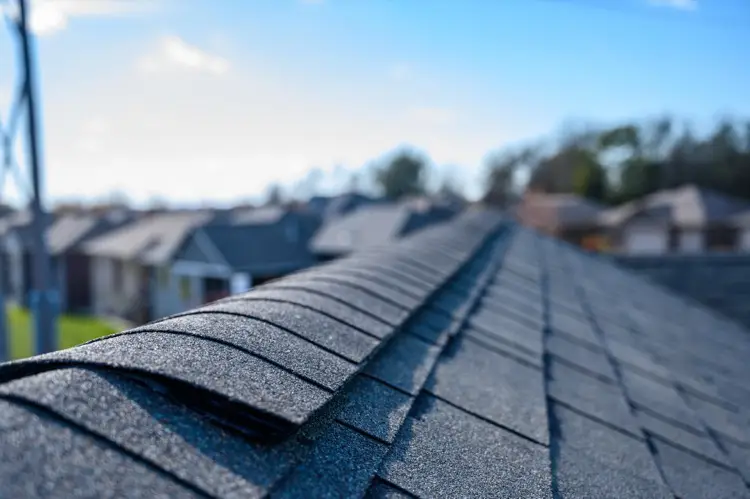
Your roof ridge is one of those things you probably never think about until something goes wrong. It is the horizontal line that runs along the very top of your roof, where the two sloped sides meet. It is the highest point of the whole structure.
What Does a Roof Ridge Actually Do?
Quick Answer: The ridge serves as both the structural backbone of your roof and the primary exit point for hot air leaving your attic.
The ridge board, the beam running inside the peak, connects every rafter in your roof frame. It distributes the weight of the entire structure evenly across your walls. Without it, certain areas bear more load than they should, and over time that leads to sagging, cracking, or worse. The ridge and valleys are part of what a roof inspection covers, because that is where roofs fail first.
On the outside, the ridge is where your ridge cap shingles and ridge vent sit. The cap seals the peak against rain and wind. The vent lets hot air escape. When either one fails, it is usually a roof repair rather than a full replacement. Together, they handle two of the most important jobs on the whole roof, and they are both exposed to more heat and weather than any other part.

“The ridge cap is usually one of the first things to deteriorate on a roof. All that heat rises to the peak, and if there isn’t enough ventilation, it strips the granules right off the shingle. Once it’s down to the fiberglass mat, it goes fast. You’ll see them buckle, crumble, bubble up.”
Why Does Roof Ridge Ventilation Matter So Much?
Quick Answer: Without proper ventilation at the ridge, heat and moisture get trapped in your attic, damaging shingles from underneath, driving up energy bills, and shortening your roof's lifespan.
Ventilation is not optional. Here is what it prevents:
- Moisture damage: Trapped moisture in your attic leads to mold, mildew, and wood rot. Over time, it weakens the roof structure from the inside.
- Premature shingle deterioration: Excessive attic heat bakes shingles from below, especially at the ridge. This is the number one reason ridge caps fail early.
- Ice dams in winter: When heat escapes unevenly, it melts snow on the upper roof, which refreezes at the eaves and backs up under shingles. Here is our full guide to preventing ice dams in Indiana.
- High energy bills: A poorly ventilated attic traps hot air in summer, forcing your HVAC system to work harder.
The roof ridge is the exhaust side of this system. But it can only do its job if there is intake air coming in from below.
What Are the Different Ways to Ventilate a Roof?
Quick Answer: Ridge vents paired with soffit vents are the standard for most homes. Gable vents and turbine vents work as alternatives when the roof design does not allow a ridge-and-soffit setup.
Ridge Vents
The most common and effective option for most homes. Ridge vents run along the peak of the roof, creating a continuous opening for hot air to escape. They work with the natural tendency of warm air to rise, so there are no mechanical parts and nothing to maintain.
Ridge vents are also nearly invisible from the ground. They blend into the roofline, which makes them popular with homeowners who care about curb appeal.
But they only work if you have intake vents at the bottom.
Soffit Vents
Soffit vents sit under the eaves, pulling cool air into the attic from below. This incoming air pushes hot air up and out through the ridge vent at the peak. Together, they create a passive loop that runs 24 hours a day without any power or moving parts.
When your soffit vents get blocked by insulation, debris, or paint, the whole system stalls. That is one of the first things we check during an inspection.
“If a home doesn’t have soffit vents, the builder should have put gable vents in already. If neither one is there, we need to add an inflow roof vent or gable vents before the ridge vent can do its job.”
Gable Vents
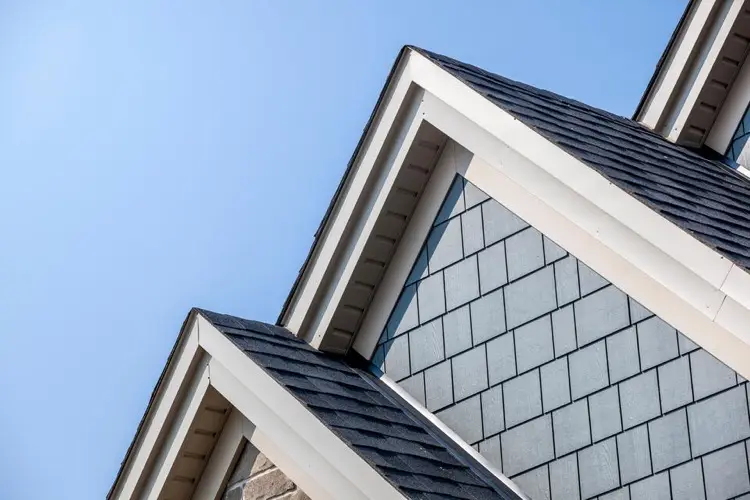
Gable vents sit on the triangular wall sections at either end of the attic. They let air flow horizontally through the space and are common in older homes. They are not as efficient as the ridge-and-soffit combination, but they work well as a supplement or as a backup when soffit vents are not an option.
Turbine Vents
Turbine vents (sometimes called whirlybirds) use wind power to spin and actively pull hot air out of the attic. They are a practical choice in areas with consistent wind, especially on roofs where passive venting is not moving enough air. They do require occasional maintenance to keep the bearings turning smoothly.
What Does Roof Ridge Damage Actually Look Like?
Quick Answer: Ridge cap shingles buckle, crumble, or lose their granules long before the rest of the roof. If you can see bare fiberglass mat from the ground, the ridge is already failing.
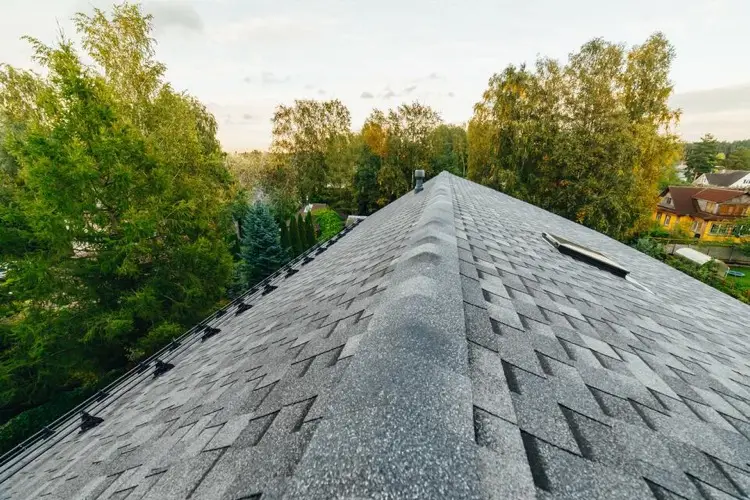
We see it all the time. A homeowner calls about a leak or a draft, and when we get up there, the ridge is the problem. The cap shingles have lost their granules, buckled, or started to crumble. Once the protective surface is gone, the underlying fiberglass mat degrades quickly.
The most common causes:
- Inadequate ventilation: Heat builds up at the peak with no way to escape. Over time, it cooks the ridge cap from underneath.
- Age: Even on a well-ventilated roof, the ridge takes more weather and UV exposure than any other part. It simply wears out first.
- Wrong ridge cap material: Some contractors use off-brand ridge caps or cut standard three-tab shingles to fit. That can work in a pinch, but the color often does not match, and the wind rating is lower.
“I see people use actual roof shingles to do the ridge, or they use a product called Supreme, which is an older Owens Corning three-tab. The colors never quite match, and the wind warranty is half what you get with a proper Pro Edge ridge cap. Pro Edge is perforated so you just bend and peel, and each piece gives you a clean line. It’s quicker to install and it’s part of the full Owens Corning system warranty.”
What Our Customers Say:
"Larry and Lyle were patient with all of my questions along the way and not pushy sales people at all. They were honest about what needed to be done and priced very fairly. The work was done quickly and efficiently and is of high quality."
Rachel H., Indiana
Can Snow Get Into Your Attic Through the Ridge Vent?
Quick Answer: It can, if the ridge vent does not have the right backer material. A quality ridge vent with a proper internal baffle stops snow and rain from blowing through.
This is a question Indiana homeowners ask a lot, especially after a winter with heavy wind-driven snow. The short answer: yes, it is possible, but it should not happen on a properly installed ridge vent.
The issue comes down to the backer on the vent itself. Cheaper ridge vents, or vents that have been installed without the right closure pieces, can let snow blow up through the gap and into the attic. We have seen attics with snow drifts inside because the ridge vent had no internal baffle at all.
If the ridge vent runs all the way to the edge of the roof without proper end closures, rain can also blow into the ends. And in some designs, critters can find their way in through the gaps.
“What we’ve seen most often is snow blowing up through the ridge ventilation and into the attic. That happens when the vent doesn’t have the proper backer on it. A good ridge vent has an internal filter that lets air through but blocks moisture and debris.”
What Is Step Flashing, and Why Does It Matter at the Ridge?
Quick Answer: Step flashing is the hidden metalwork that keeps water from getting behind your shingles where the roof meets a wall, chimney, or dormer. Most homeowners never see it, but it is one of the most important parts of a quality roof installation.
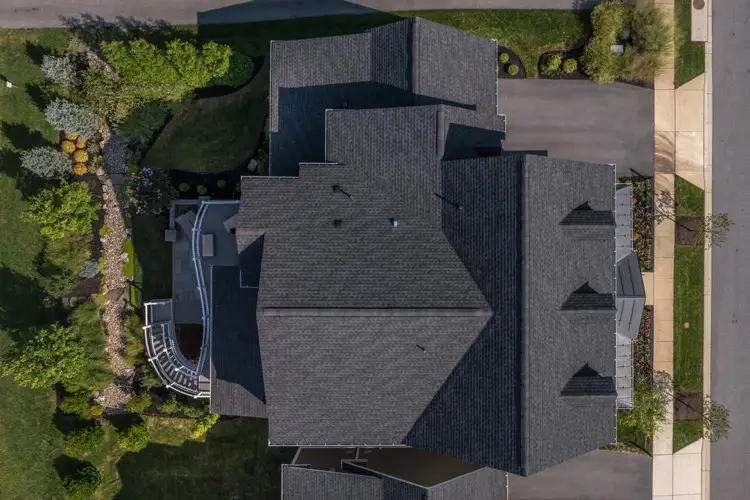
Where your roof meets a vertical surface like a wall or chimney, water needs somewhere to go. Step flashing is a series of small metal pieces woven into the shingle courses to channel that water safely down and off the roof.
When we pull off an old roof, we always check the flashing. If it is still in good condition, properly staggered and intact, it can last another full roof cycle. But if the home has wood siding or stucco, we take extra steps.
“If we’ve got wood siding or stucco, we cut three and a half inches up, put our new flashing in, add a new one-by-four piece of wood, and wrap it in aluminum trim to match the siding. You’ll never see it, but it’s what keeps water out for the next 20 years.”
What Our Customers Say:
"Outstanding experience from start to finish working with these guys. They're detail oriented, communicative, flexible, and they keep their word. I couldn't have asked for a better company to help me manage a very stressful situation!"
Jonathon E., Indiana
This article is part of our guide to understanding every part of your roof.
Not sure your ridge is doing its job?
If your roof is over 10 years old, the ridge is the first place ventilation problems and shingle wear show up. Book a free assessment and we'll tell you honestly.
Get My Free AssessmentNo Pressure, Excellent Installers
Salesman was not pushy. Excellent installers. On time. Friendly. And the roof looks great.
No Surprise Charges at the End
When the job was finished, you would never know they were here. The clean up was fantastic. Best of all, at the completion of the job, there were no surprise additional charges.
They Told Us One Roof Could Wait
We actually had two roofs to be evaluated. One roof had areas of severe granulation loss and was recommended for replacement... The other roof they said could wait 3-5 years.
Kept My Yard Clean
Great communication, didn't try to upsell anything. Professional install, cleaned up the mess and made sure to take precautions to keep my yard clean during the work with tarps and raised dumpsters.
They Answered on Christmas Eve
Super responsive and checked out my roof on Christmas Eve when other companies did not even answer phone. John was an excellent communicator and helped me sort thru what was best for my house.
Fast and Fairly Priced
Fixed our roof in a timely manner, at a very reasonable price.
Frequently Asked Questions
How long does a roof ridge cap last?
With proper ventilation and quality materials, a ridge cap should last as long as the rest of the roof: 25 to 30 years for architectural shingles. Without adequate ventilation, the ridge cap deteriorates first because it takes the most heat.
Can you replace just the ridge cap without replacing the whole roof?
Yes. If the rest of the shingles are in good condition but the ridge is failing, a roofer can replace just the cap. If the shingles around it are also near the end of their life, a full roof replacement is usually the better value. It is a common and straightforward repair.
Do all roofs need a ridge vent?
Most pitched roofs benefit from ridge ventilation, but some designs, like hip roofs with very short ridges, may use alternative venting. Your roofer should assess what your specific roof needs.
What is the difference between a ridge vent and a ridge cap?
The ridge cap is the row of shingles that covers and seals the peak. The ridge vent sits underneath the cap, creating a gap for airflow. You need both: the vent for ventilation, the cap for weatherproofing.
Last updated: September 13, 2026